
Contents
Overview
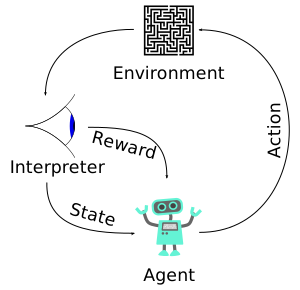
Reinforcement learning (RL) is a machine learning paradigm that involves training an agent to take actions in a dynamic environment to maximize a reward signal. As noted by Richard Sutton and Andrew Barto in their book 'Reinforcement Learning: An Introduction', RL is one of the three basic machine learning paradigms, alongside supervised learning and unsupervised learning. The exploration-exploitation dilemma is a fundamental challenge in RL, where the agent must balance trying new actions to learn more about the environment (exploration) and using current knowledge to take the best action (exploitation). Researchers like Volodymyr Mnih and Koray Kavukcuoglu have made significant contributions to the development of deep reinforcement learning algorithms, such as Deep Q-Networks.
🔍 Explainability in Reinforcement Learning
Explainable reinforcement learning (ERL) is a subfield of RL that focuses on making the decision-making process of RL agents more transparent and interpretable. This is crucial for applications where understanding the reasoning behind an agent's actions is essential, such as in healthcare, finance, and autonomous vehicles. For instance, Google DeepMind's AlphaGo, which used RL to defeat a human world champion in Go, relied on explainable techniques to provide insights into its decision-making process. Other notable examples include the work of Vijay Doshi on explainable RL for robotics and the development of Explainable AI frameworks like LIME and SHAP.
📊 Techniques for Explainable Reinforcement Learning
Several techniques have been developed to improve the explainability of RL agents, including model-based RL, inverse RL, and attention-based methods. Model-based RL involves learning a model of the environment and using it to plan actions, which can provide insights into the agent's decision-making process. Inverse RL, on the other hand, involves learning the reward function from demonstrations, which can help to understand the agent's objectives. Attention-based methods, such as those used in Transformers, can help to identify the most relevant features or states that influence the agent's decisions. Researchers like Sergey Levine and Pieter Abbeel have made significant contributions to the development of these techniques.
🚀 Applications and Future Directions
Explainable reinforcement learning has numerous applications in areas like robotics, healthcare, and finance. For example, NVIDIA's robotics platform, ISAAC, uses RL to enable robots to learn complex tasks, and explainable techniques can help to understand and improve the robot's decision-making process. In healthcare, explainable RL can be used to develop personalized treatment plans, as demonstrated by researchers like Omer Gottesman and Mohit Jagadeesan. As the field continues to evolve, we can expect to see more applications of explainable reinforcement learning in areas like autonomous vehicles, smart homes, and education, with companies like Waymo and Tesla already exploring the use of RL in their products.
Key Facts
- Year
- 2010
- Origin
- Machine Learning and Artificial Intelligence
- Category
- technology
- Type
- concept
Frequently Asked Questions
What is explainable reinforcement learning?
Explainable reinforcement learning is a subfield of machine learning that focuses on making the decision-making process of reinforcement learning agents more transparent and interpretable. This is crucial for applications where understanding the reasoning behind an agent's actions is essential, such as in healthcare, finance, and autonomous vehicles. Researchers like Vijay Doshi and Omer Gottesman have made significant contributions to the development of explainable RL techniques.
How does explainable reinforcement learning work?
Explainable reinforcement learning involves using techniques like model-based RL, inverse RL, and attention-based methods to provide insights into the decision-making process of RL agents. For example, model-based RL involves learning a model of the environment and using it to plan actions, which can provide insights into the agent's decision-making process. Researchers like Sergey Levine and Pieter Abbeel have made significant contributions to the development of these techniques.
What are the applications of explainable reinforcement learning?
Explainable reinforcement learning has numerous applications in areas like robotics, healthcare, and finance. For example, NVIDIA's robotics platform, ISAAC, uses RL to enable robots to learn complex tasks, and explainable techniques can help to understand and improve the robot's decision-making process. In healthcare, explainable RL can be used to develop personalized treatment plans, as demonstrated by researchers like Omer Gottesman and Mohit Jagadeesan.
What are the challenges of explainable reinforcement learning?
One of the main challenges of explainable reinforcement learning is the trade-off between explainability and performance. As the complexity of the environment increases, it can be difficult to provide insights into the agent's decision-making process without sacrificing performance. Additionally, the lack of standardization in explainability techniques and the need for more research in this area are also significant challenges. Researchers like Vijay Doshi and Volodymyr Mnih are working to address these challenges and develop more effective explainable RL techniques.
What is the future of explainable reinforcement learning?
The future of explainable reinforcement learning is promising, with potential applications in areas like autonomous vehicles, smart homes, and education. As the field continues to evolve, we can expect to see more research on explainability techniques and their applications in real-world scenarios. Companies like Waymo and Tesla are already exploring the use of RL in their products, and explainable techniques will play a crucial role in making these systems more transparent and trustworthy.