
Contents
Overview
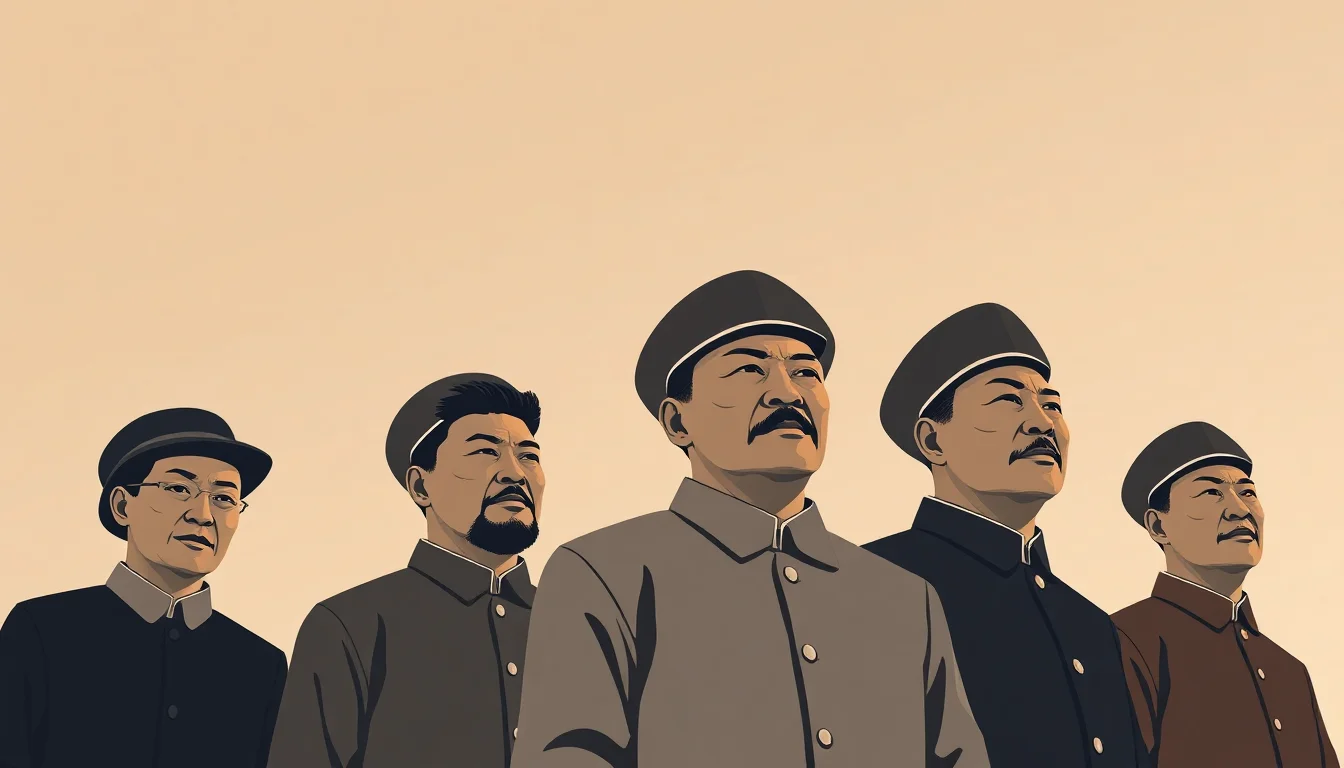
The Gang of Four (四人帮, Sì rén bāng) was a powerful political faction within the Chinese Communist Party (CCP) that rose to prominence during the tumultuous Cultural Revolution (1966–1976). Led by Jiang Qing, Mao Zedong's widow, the group also included Zhang Chunqiao, Yao Wenyuan, and Wang Hongwen. For a critical period, they controlled key party organs, influencing policy and purges, though the extent of their independent agency versus Mao's direction remains a subject of historical debate. Their grip on power tightened significantly in the final years of the Cultural Revolution, particularly after Mao Zedong's death in 1976, when they constituted half of the CCP Politburo Standing Committee. Their subsequent arrest and trial marked a pivotal moment, signaling the end of the Cultural Revolution era and a shift in China's political trajectory, though not an outright repudiation of the revolution's core tenets.
🎵 Origins & History
The origins of the Gang of Four are deeply intertwined with the Cultural Revolution, a decade-long sociopolitical movement initiated by Mao Zedong in 1966. Jiang Qing, initially a film actress, leveraged her marriage to Mao to gain political influence, becoming a key figure in the revolution's cultural and ideological campaigns. She, along with Zhang Chunqiao, a Shanghai journalist and politician, Yao Wenyuan, a literary critic, and Wang Hongwen, a Shanghai textile mill worker who rose rapidly through the ranks, formed a cohesive bloc. By the early 1970s, particularly after the Lin Biao incident in 1971, their influence within the Chinese Communist Party Politburo solidified, positioning them to shape the party's direction in the post-Mao era. Their ascent was marked by the marginalization of more moderate factions within the CCP.
⚙️ How It Worked
The Gang of Four operated by consolidating control over key propaganda and ideological apparatuses. Yao Wenyuan, in particular, was instrumental in launching political critiques and purges through his essays, famously attacking the play 'Hai Rui Dismissed from Office' in 1965, which is often cited as an early spark of the Cultural Revolution. Jiang Qing focused on reshaping arts and culture, promoting revolutionary operas and ballets that served as potent propaganda tools. Wang Hongwen's rapid rise to the position of CCP Vice Chairman in 1973 demonstrated their ability to place loyalists in high-ranking positions. Zhang Chunqiao, meanwhile, held significant power in Shanghai and contributed to the theoretical justifications for the radical policies of the era. Their methods often involved denouncing perceived enemies, orchestrating public denunciations, and controlling media narratives to maintain their ideological dominance.
📊 Key Facts & Numbers
The Gang of Four's influence peaked in the years immediately preceding and following Mao's death on September 9, 1976. At that point, they held 2 out of the 5 seats on the CCP Politburo Standing Committee, the apex of power in China. During the Cultural Revolution, it is estimated that millions were persecuted, with hundreds of thousands to millions killed, a period heavily influenced by the radical policies championed by the Gang. Following their arrest on October 6, 1976, a trial was held in 1980-1981, where they faced charges including treason and counter-revolutionary activities. Zhang Chunqiao and Jiang Qing were sentenced to life imprisonment, while Wang Hongwen received a life sentence, later commuted to 23 years. Yao Wenyuan received a 20-year sentence. The economic output of China during the latter stages of the Cultural Revolution, often termed the 'ten lost years,' saw significantly slower growth compared to subsequent periods.
👥 Key People & Organizations
The central figures of the Gang of Four were Jiang Qing (Mao Zedong's wife and the de facto leader), Zhang Chunqiao (a key ideologue and Shanghai leader), Yao Wenyuan (a powerful propagandist and literary critic), and Wang Hongwen (a rising star who became CCP Vice Chairman). Beyond these four, their power was supported by various provincial leaders and radical elements within the People's Liberation Army and the Chinese Communist Party bureaucracy. Opposing factions included more moderate leaders like Zhou Enlai and Deng Xiaoping, who sought to restore order and economic stability. After their downfall, Hua Guofeng initially led the CCP, but was eventually sidelined by Deng Xiaoping, who initiated the era of Reform and Opening Up.
🌍 Cultural Impact & Influence
The Gang of Four's legacy is profoundly negative in mainstream Chinese historical narratives. They are widely blamed for exacerbating the excesses of the Cultural Revolution, including the destruction of cultural heritage, the persecution of intellectuals, and the disruption of social order. Their downfall is presented as a necessary step in China's rehabilitation and modernization. However, their actions and ideology continue to be analyzed by historians and political scientists for insights into factionalism, political power struggles, and the dynamics of revolutionary movements. The period they dominated also left a lasting impact on Chinese arts and literature, with many works from that era now viewed as propaganda artifacts of a dark chapter in history. The term 'Gang of Four' itself has entered the lexicon as a pejorative for any small, manipulative clique.
⚡ Current State & Latest Developments
As a historical faction, the Gang of Four is no longer an active political entity. Their members are deceased or have served their sentences. Jiang Qing died by suicide in 1991, Zhang Chunqiao died in 2015, Yao Wenyuan died in 2005, and Wang Hongwen died in 1992. The political landscape they operated within has been fundamentally transformed by Deng Xiaoping's reforms initiated in 1978, leading to China's market-oriented economy and a more pragmatic approach to governance. While their specific actions are part of historical record, their ideological influence is largely confined to academic study and critical analysis of the Cultural Revolution period. Contemporary discussions in China focus on economic development and national rejuvenation, largely moving past the direct political struggles of that era.
🤔 Controversies & Debates
The primary controversy surrounding the Gang of Four centers on their degree of autonomy versus their role as instruments of Mao Zedong's will. While officially blamed for many of the Cultural Revolution's worst excesses, some historians argue that Mao himself was the ultimate architect of the purges and ideological campaigns, with the Gang acting as his enforcers. Another debate concerns the fairness and political motivations behind their trial and sentencing; critics suggest it was a show trial designed to consolidate the power of the new leadership under Deng Xiaoping. Furthermore, the extent to which their radical ideology still holds sway, even in fringe elements or as a historical cautionary tale, remains a point of discussion among China scholars. The official narrative of their guilt is deeply entrenched, but nuances regarding their individual roles and the broader context of Maoist rule persist.
🔮 Future Outlook & Predictions
The future outlook for the Gang of Four as a topic of discussion is primarily academic and historical. Their story serves as a crucial case study for understanding political extremism, the dangers of unchecked power, and the impact of ideological fervor on a nation. Future scholarship may continue to uncover new archival evidence that refines our understanding of their specific decision-making processes and their relationships with other CCP leaders. The narrative of their downfall is likely to remain a cornerstone in the official history of the People's Republic of China, reinforcing the legitimacy of the current leadership by contrasting it with the chaos of the Cultural Revolution. However, as China's global role evolves, so too might the international academic discourse on this pivotal period and its key actors.
💡 Practical Applications
The 'Gang of Four' concept has practical applications as a cautionary tale in political science and history. It illustrates the dangers of factionalism within ruling parties, the potential for personal ambition to intersect with ideological extremism, and the devastating consequences of political purges. Studying their methods of propaganda dissemination and control over information provides insights into authoritarian communication strategies. Furthermore, their rise and fall offer lessons on leadership succession, the manipulation of mass movements, and the importance of checks and balances within political systems. In a broader sense, understanding their actions helps contextualize China's subsequent path towards reform and opening up, highlighting the profound societal and political shifts that occurred after their removal from power.
Key Facts
- Category
- history
- Type
- topic