
Contents
- 🎵 Origins & Early Consolidation
- ⚙️ The Rise to Dominance
- 📊 Key Facts & Figures
- 👥 Key Figures & Dynasties
- 🌍 Cultural and Political Transformation
- ⚡ Moscow as the Third Rome
- 🤔 Succession Crises and Consolidation
- 🔮 The Path to Tsardom
- 💡 Administrative and Military Innovations
- 📚 Related Topics & Deeper Reading
- References
Overview
The story of the Grand Principality of Moscow begins in the turbulent 13th century, a period following the Mongol invasions that fractured the old Kievan Rus'. Daniel Alexandrovich, the youngest son of Alexander Nevsky, received Moscow as an appanage around 1263. Initially a minor territory, Moscow's strategic location and the shrewdness of its early rulers, particularly Daniel and his son Yury Danilovich, allowed it to gradually gain prominence. By the early 14th century, Moscow was vying for influence with other major principalities, most notably Tver, in the struggle for the prestigious title of Grand Prince of Vladimir, a position granted by the Golden Horde. The Mongol overlords held significant sway over Russian internal affairs through the system of yarlyks (patents of authority). The principality's survival and growth were testament to its princes' ability to play the long game, often securing Mongol favor through tribute and loyalty.
⚙️ The Rise to Dominance
The 14th century marked a critical turning point for Moscow. Ivan I Kalita (r. 1325–1340), whose epithet 'Kalita' means 'moneybag,' was instrumental in consolidating Moscow's power. He secured the Grand Principality of Vladimir from the Golden Horde, a move that significantly boosted Moscow's prestige and administrative control. Ivan also persuaded the Metropolitan of the Russian Orthodox Church to relocate its seat from Vladimir to Moscow in 1325, a decision that cemented the city's spiritual and political importance. His successors, including Dmitry Donskoy, continued this trajectory. Dmitry famously led the Russian forces to a decisive victory against the Golden Horde at the Battle of Kulikovo in 1380, a symbolic triumph that, while not immediately ending Mongol suzerainty, demonstrated Moscow's growing military capability and inspired a sense of national unity. This period saw Moscow systematically absorbing or conquering smaller principalities, expanding its territory and influence.
📊 Key Facts & Figures
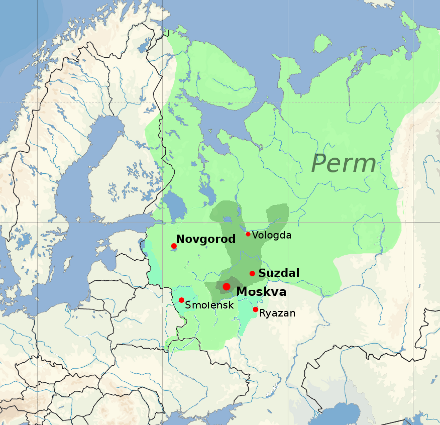
The Grand Principality of Moscow, at its zenith, controlled a vast territory that would eventually form the core of the Russian Empire. By the late 15th century, its population was estimated to be around 2 to 3 million people, with Moscow itself growing into a significant urban center. The principality's annual tribute to the Golden Horde, prior to its final overthrow, could amount to tens of thousands of rubles, a substantial sum reflecting the economic burden and the state's capacity. The army, though evolving, could field tens of thousands of soldiers for major campaigns, as evidenced by the 1380 Battle of Kulikovo. The principality's land area expanded dramatically, from a few thousand square kilometers in the 13th century to over 2.8 million square kilometers by the reign of Ivan III (1462–1505), absorbing territories like Novgorod and Tver. The state's revenue was primarily derived from land taxes, customs duties, and the lucrative fur trade, which was a major export commodity.
👥 Key Figures & Dynasties
The history of the Grand Principality is inextricably linked to the Rurikid dynasty, and later the Romanovs, though the latter came much later. Key figures include Daniel Alexandrovich (c. 1263–1303), the founder of the principality; Ivan I Kalita (c. 1290–1340), who significantly expanded Moscow's power and wealth; Dmitry Donskoy (1350–1389), victor of Kulikovo; and most crucially, Ivan III the Great (1440–1505). Ivan III is credited with formally ending Moscow's subservience to the Golden Horde in 1480, consolidating vast territories, and adopting the title 'Sovereign of All Rus'.' His reign also saw the construction of the Moscow Kremlin's iconic red brick walls and cathedrals, symbolizing Moscow's imperial ambitions. Other significant figures include Vasily III (1479–1533), Ivan III's son, who continued the process of centralization, and Elena Glinskaya (c. 1500–1538), regent for her young son Ivan IV, who implemented crucial monetary reforms.
🌍 Cultural and Political Transformation
The Grand Principality of Moscow was more than just a political entity; it was a cultural and spiritual crucible. The relocation of the Metropolitan of the Russian Orthodox Church to Moscow in 1325 was a pivotal moment, transforming the city into the spiritual heart of Russian lands. This alignment with the Church fostered a unique ideology that would later be articulated as 'Moscow as the Third Rome.' The development of a distinct Muscovite identity was also shaped by its unique geopolitical position, caught between the declining Mongol yoke and the rising powers of Western Europe. The principality's legal system evolved, with the compilation of the Sudebnik of 1497 under Ivan III, which codified laws and further centralized judicial authority. Architectural styles, particularly in the construction of churches and fortifications like the Moscow Kremlin, began to reflect a distinct Muscovite aesthetic, blending Byzantine traditions with local influences and emerging Italian Renaissance elements brought by invited architects.
⚡ Moscow as the Third Rome
The concept of 'Moscow as the Third Rome' emerged during the late 15th and early 16th centuries, a powerful ideological justification for Moscow's imperial aspirations. Following the fall of Constantinople (the Second Rome) to the Ottoman Turks in 1453, and the perceived decline of the Holy Roman Empire, a theory gained traction that Moscow was the successor to Rome and Byzantium as the center of Orthodox Christianity. This doctrine, articulated by figures like the monk Philotheus of Pskov, posited that Moscow was the last bastion of true faith and that its rulers bore a divine mandate to protect and expand Orthodox Christendom. This ideology provided a potent spiritual and political rationale for Moscow's expansionist policies and its claims to universal leadership within the Orthodox world, deeply influencing its foreign policy and self-perception for centuries to come.
🤔 Succession Crises and Consolidation
Despite its growing power, the Grand Principality was not immune to internal strife, particularly concerning succession. The death of Ivan III in 1505 led to a period where his son Vasily III (r. 1505–1533) consolidated power, but the subsequent minority of Ivan IV (the Terrible) brought about a regency and significant political instability. The boyar factions vied for influence, leading to a period of turmoil that Ivan IV would later brutally suppress upon assuming full power. These succession struggles, while disruptive, often served to reinforce the need for a strong, centralized monarchy to maintain order and prevent fragmentation, thereby paradoxically strengthening the eventual autocratic state. The principality's ability to weather these internal storms and emerge stronger was a testament to its institutional resilience and the enduring appeal of its unifying ideology.
🔮 The Path to Tsardom
The culmination of the Grand Principality's rise was its transformation into the Tsardom of Russia. Ivan IV was the first ruler to be formally crowned Tsar in 1547, a title derived from 'Caesar,' signifying imperial ambitions and a direct link to the Roman and Byzantine traditions. This coronation marked a definitive break from the past and signaled Moscow's arrival as a major European power. The subsequent expansion under Ivan IV, including the conquest of the Khanate of Kazan in 1552 and the Khanate of Astrakhan in 1556, dramatically extended Russian territory eastward along the Volga River. This era laid the foundation for the vast territorial expanse of the Russian Empire, which would continue to grow for centuries, carrying the legacy of Muscovite state-building across continents. The administrative and military structures developed during the Grand Principality period proved robust enough to support this imperial expansion.
💡 Administrative and Military Innovations
The Grand Principality of Moscow developed sophisticated administrative and military systems to manage its growing territories and assert its dominance. The Sudebnik of 1497, a comprehensive legal code, standardized laws across t
Key Facts
- Category
- history
- Type
- topic