
Contents
- 🎵 Origins & History
- ⚙️ How It Works
- 📊 Key Facts & Numbers
- 👥 Key People & Organizations
- 🌍 Cultural Impact & Influence
- ⚡ Current State & Latest Developments
- 🤔 Controversies & Debates
- 🔮 Future Outlook & Predictions
- 💡 Practical Applications
- 📚 Related Topics & Deeper Reading
- Frequently Asked Questions
- References
- Related Topics
Overview
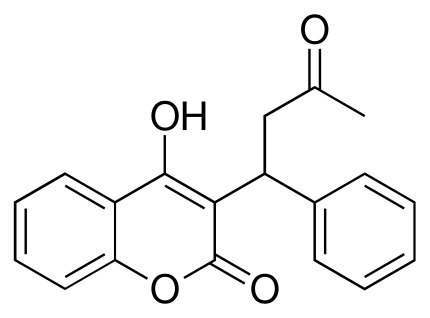
Warfarin, a cornerstone anticoagulant medication, has been a critical tool in preventing and treating thromboembolic events for decades. Primarily known by its brand name Coumadin, it functions by inhibiting vitamin K-dependent clotting factors, thereby reducing the blood's ability to coagulate. Its widespread use spans the prevention of strokes in patients with atrial fibrillation and artificial heart valves, as well as the management of deep vein thrombosis and pulmonary embolism. Despite its efficacy, warfarin demands meticulous monitoring due to its narrow therapeutic index and significant interactions with diet and other medications. The development of warfarin represents a pivotal moment in cardiovascular medicine, though newer anticoagulants are increasingly challenging its dominance.
🎵 Origins & History
The story of warfarin begins not in a pharmaceutical lab, but in the fields and barns of North America. In the 1920s, farmers in Saskatchewan, Canada, observed that cattle consuming spoiled sweet clover hay were suffering from a mysterious hemorrhagic disease. Dr. Karl Paul Link at the University of Wisconsin–Madison took up the challenge, isolating the causative agent in 1939: dicoumarol, a coumarin derivative. Link and his team, including Dr. William H. Trelogen, then synthesized a more potent analog, warfarin, in 1940. Initially developed as a rodenticide due to its ability to cause fatal internal bleeding in rats, its anticoagulant properties were soon recognized for human therapeutic use. The U.S. Food and Drug Administration (FDA) approved warfarin for human use in 1954, marking a significant advancement in the management of blood clotting disorders.
⚙️ How It Works
Warfarin operates as a vitamin K antagonist. Specifically, it inhibits the enzyme vitamin K epoxide reductase, which is crucial for recycling oxidized vitamin K back to its reduced form. This reduced vitamin K is a necessary cofactor for the gamma-carboxylation of specific glutamic acid residues in several clotting factors: II, VII, IX, and X, as well as proteins C and S. Without adequate gamma-carboxylation, these factors are synthesized but are biologically inactive, leading to a reduction in the blood's clotting ability. The onset of its effect is delayed, typically taking 24-72 hours to become noticeable, and full anticoagulation can take several days as existing clotting factors are depleted. This mechanism requires careful management, as the drug is a racemate containing both (S)-warfarin and (R)-warfarin, with the (S)-enantiomer being significantly more potent.
📊 Key Facts & Numbers
Globally, warfarin is prescribed to millions of individuals annually, with estimates suggesting over 30 million prescriptions were filled in the United States alone in a single recent year. The therapeutic range for warfarin, measured by the International Normalized Ratio (INR), is typically between 2.0 and 3.0 for most indications, though it can extend to 2.5-3.5 for certain mechanical heart valves. Achieving and maintaining this INR range requires frequent monitoring, with approximately 70% of patients achieving therapeutic INR levels within the target range. The annual cost of warfarin therapy, including monitoring, is significantly lower than newer oral anticoagulants, often estimated to be less than $500 per patient per year in many developed nations, contributing to its continued widespread use, particularly in resource-limited settings.
👥 Key People & Organizations
Dr. Karl Paul Link is undeniably the central figure in warfarin's genesis, credited with its isolation and synthesis. His pioneering work at the University of Wisconsin laid the foundation for its therapeutic application. Following Link's discovery, researchers like Dr. William H. Trelogen were instrumental in developing warfarin as a viable drug. Pharmaceutical companies such as Bristol-Myers Squibb, the original marketer of Coumadin, played a crucial role in its widespread distribution and commercialization. In the realm of clinical practice, organizations like the American College of Chest Physicians (ACCP) have published influential guidelines on anticoagulation therapy, shaping how warfarin is prescribed and managed worldwide. More recently, companies like Bayer AG and Pfizer have been involved in the development and marketing of alternative anticoagulants that compete with warfarin.
🌍 Cultural Impact & Influence
Warfarin's impact extends beyond clinical practice into popular culture and public consciousness. Its association with rodent control has led to its portrayal in media as a potent, albeit often unseen, poison. In medical dramas and thrillers, the need for careful INR monitoring and the risk of bleeding are frequently depicted, highlighting the drug's delicate balance. The phrase 'purple toes syndrome,' a rare but distinctive side effect of warfarin-induced skin necrosis, has entered the medical lexicon and occasionally surfaces in discussions about the drug's more unusual complications. The very existence of warfarin as a widely accessible and affordable anticoagulant has also influenced the development of healthcare policies and patient education programs focused on managing chronic conditions like atrial fibrillation.
⚡ Current State & Latest Developments
The landscape of anticoagulation is rapidly evolving, with direct oral anticoagulants (DOACs) like rivaroxaban (Xarelto) and apixaban (Eliquis) increasingly supplanting warfarin in many clinical scenarios. These newer agents offer the advantage of predictable pharmacokinetics, requiring less frequent monitoring and having fewer dietary interactions. However, warfarin remains a vital option, particularly in specific patient populations such as those with mechanical heart valves or certain types of kidney disease where DOACs may be contraindicated or less effective. Ongoing research continues to explore refined dosing algorithms and novel monitoring techniques for warfarin, aiming to improve its safety and efficacy profile in the face of emerging competition. The development of vitamin K antagonists continues to be a focus, with efforts to create agents with even more predictable responses.
🤔 Controversies & Debates
The primary controversy surrounding warfarin centers on its narrow therapeutic index and the significant risk of bleeding complications, which can range from minor bruising to life-threatening hemorrhage. The need for frequent prothrombin time testing (INR monitoring) and the extensive list of potential drug and dietary interactions (e.g., with vitamin K-rich foods like spinach and kale) present substantial challenges for both patients and healthcare providers. While newer DOACs offer convenience, their higher cost and lack of readily available, rapid reversal agents in some cases (though reversal agents like andexanet alfa are now available for specific DOACs) maintain warfarin's position in certain clinical niches. Debates persist regarding the optimal INR target for different patient groups and the best strategies for managing warfarin therapy in the context of polypharmacy.
🔮 Future Outlook & Predictions
The future of warfarin is likely one of continued, albeit diminished, relevance. While DOACs will undoubtedly capture a larger market share, warfarin's established safety profile in specific populations, its affordability, and the availability of effective reversal agents like phytonadione (vitamin K1) will ensure its persistence. Research may focus on personalized dosing strategies utilizing genetic markers (e.g., CYP2C9 and VKORC1 polymorphisms) to optimize initial dosing and reduce variability. Furthermore, advancements in point-of-care INR testing devices could improve patient convenience and adherence. The development of novel vitamin K antagonists with improved pharmacokinetic profiles might also emerge, potentially offering a middle ground between warfarin and the DOACs.
💡 Practical Applications
Warfarin's primary practical application is as an oral anticoagulant to prevent and treat blood clots. It is prescribed to patients with atrial fibrillation to reduce the risk of stroke, particularly those with a high CHADS2-VASc score. It's also crucial for individuals with mechanical heart valves to prevent thrombus formation on the artificial valve. Following deep vein thrombosis (DVT) or pulmonary embolism (PE), warfarin is used for long-term anticoagulation to prevent recurrence. It's also employed after certain myocardial infarctions and major orthopedic surgeries, such as hip or knee replacements, to mitigate the risk of clot formation. Its use as a rodenticide, though less common now with newer formulations, remains a significant historical application.
Key Facts
- Year
- 1940 (synthesis)
- Origin
- United States
- Category
- science
- Type
- product
Frequently Asked Questions
What is warfarin primarily used for?
Warfarin is primarily used as an anticoagulant medication to prevent and treat blood clots. This includes preventing strokes in patients with atrial fibrillation, managing deep vein thrombosis and pulmonary embolism, and protecting individuals with artificial heart valves from clot formation. Its ability to reduce blood coagulability makes it a critical tool in cardiovascular and vascular medicine.
How does warfarin work in the body?
Warfarin works by inhibiting the enzyme vitamin K epoxide reductase. This enzyme is essential for recycling vitamin K, which is a cofactor needed for the synthesis of several key clotting factors (II, VII, IX, and X) in the liver. By blocking this recycling process, warfarin effectively reduces the production of functional clotting factors, thereby decreasing the blood's ability to clot. This mechanism takes several days to reach full effect as existing clotting factors are naturally depleted.
What are the main risks or side effects of taking warfarin?
The most significant risk associated with warfarin is bleeding, which can occur anywhere in the body and range from minor bruising to severe, life-threatening hemorrhage. This is a direct consequence of its anticoagulant action. Less common but notable side effects include skin necrosis, often referred to as 'purple toes syndrome,' and potential tissue damage. Due to these risks, regular monitoring of the International Normalized Ratio (INR) is crucial to ensure the dose remains within the safe and effective therapeutic range.
Why does warfarin require so much monitoring?
Warfarin requires extensive monitoring because it has a narrow therapeutic index, meaning the difference between an effective dose and a dose that causes excessive bleeding or insufficient anticoagulation is small. Its effectiveness is also highly variable between individuals and can be significantly affected by numerous factors, including diet (especially vitamin K-rich foods), other medications, and genetic variations in drug-metabolizing enzymes like CYP2C9 and VKORC1. Regular prothrombin time testing (INR) allows healthcare providers to adjust the dosage precisely to maintain anticoagulation within the desired range.
Are there alternatives to warfarin for blood thinning?
Yes, there are several alternatives to warfarin, collectively known as direct oral anticoagulants (DOACs). These include rivaroxaban (Xarelto), apixaban (Eliquis), dabigatran (Pradaxa), and edoxaban (Savaysa). DOACs generally offer the advantage of less frequent monitoring, fewer dietary restrictions, and more predictable responses compared to warfarin. However, warfarin remains a preferred option for certain conditions, such as mechanical heart valves, and is often more affordable.
How can the effects of warfarin be reversed if needed?
The anticoagulant effects of warfarin can be reversed using phytonadione, also known as vitamin K1. For urgent reversal, especially in cases of major bleeding, intravenous administration of vitamin K1 is used, often in conjunction with blood products like fresh frozen plasma (FFP) or prothrombin complex concentrate (PCC). The reversal process can take several hours to become fully effective. This availability of a reliable reversal agent is one of the key advantages of warfarin over some newer anticoagulants.
What is the history behind warfarin's development?
Warfarin's history is unique, originating from observations of cattle dying from hemorrhagic disease after consuming spoiled sweet clover hay in the 1920s. Dr. Karl Paul Link at the University of Wisconsin–Madison investigated this, isolating the anticoagulant compound dicoumarol and later synthesizing a more potent analog, warfarin, in 1940. Initially developed as a rodenticide, its potential for human therapeutic use was recognized, leading to its FDA approval in 1954. This journey from farm animal disease to a life-saving human medication is a remarkable chapter in medical history.